
The Language of the Underground World: Finding "Love Town" in the Forest Floor
By the Junior Kindergarten (Juniper Berries) Educators
What began as a simple scientific inquiry into how trees communicate, the "whoosh" of the wind and the swaying of branches, quickly took us deeper. As the children moved from observing the canopy to imagining the roots, they revealed a sophisticated landscape where communication isn't just about signals, but about relational care.
Maryam's Reflection:
Throughout this inquiry into how trees communicate, we have had to pause many times to reflect on the role of "love." We initially set out to study the science of how forests talk, but the children have shown us a communication that exists beyond our usual adult understanding. In Daniel’s work with the "Loved Mushroom," we see this language in action.
Daniel begins with a binary view—shaping a poisonous threat and asking for a skeleton sign to mark the danger. But as Leila watches his hands move, She sees his thinking become fluid. He doesn’t eliminate the"bad" mushroom; he transforms it. By attaching a tiny baby mushroom to the "dangerous" roots and asking for a clay heart, he moves into that sophisticated "in-between" space where fear turns into care.
This document captures a moment where communication becomes a physical act of repair. When Daniel speaks tenderly to the broken piece— “You will be okay — I will send you love” — he proves that nature and community do not require perfection for belonging. By drawing hearts along the roots so that "love can spread everywhere," Daniel reminds us that in a truly inclusive community, everyone is welcomed and loved, especially those we initially mistook for villains.
We are grateful for Isla’s mom, Tanaya, for sharing her thoughts about Isla’s sunset in our last Curriculum Update: “I believe that children don’t see nature as separate from their lives; they bring their emotions and memories into it. By sharing this memory and moment with the tree, I am certain that she was treating the tree as her friend or family member. They are one and the same in her mind.”
This reflection captures the heart of this connection: children don't see nature as separate from themselves. Just as Isla gifted a "beautiful sunset" to a dying tree, Daniel treats his clay mushrooms as family members who deserve tenderness. By moving the broken piece to make the roots touch, he proves that nature and family are "one and the same" in his mind. Both children show us that nature isn't something to study from a distance—it is an intimate friend to be loved, repaired, and kept within the circle of the community.
From "Bad Guys" to "Love Points"
In our adult world, we often view nature through binary lenses: good or bad, helpful or poisonous. Daniel’s work with clay mushrooms perfectly captured this tension. Initially, he shaped a "poisonous mushroom," complete with a skeleton warning sign, fearing its "dangerous gas."
However, as he worked, his narrative shifted. He began to see the "in-between" space. Instead of eliminating the threat, he transformed it by attaching a baby mushroom to the roots and asking for a clay heart.
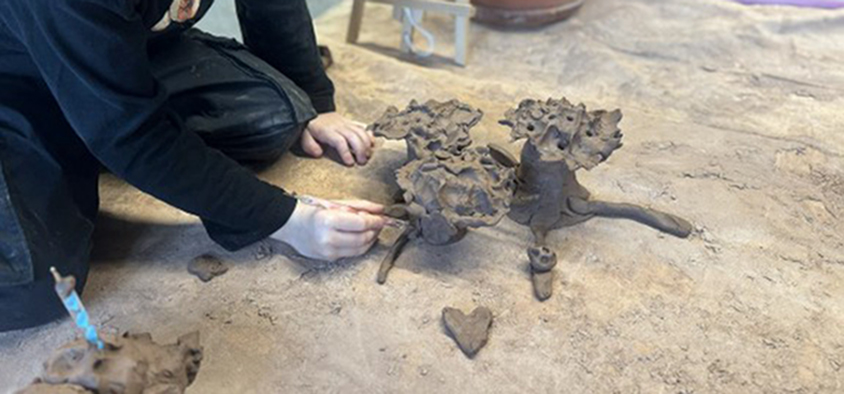
"Maybe it can make love too." - Daniel
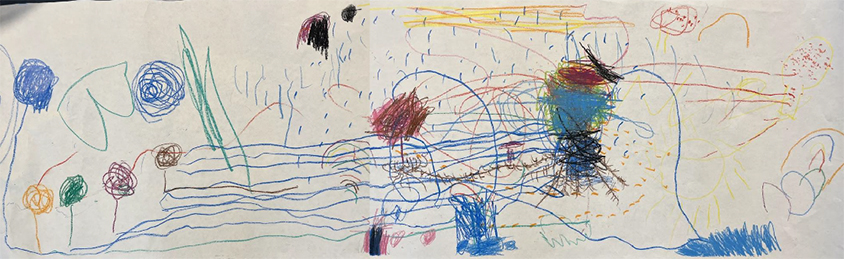
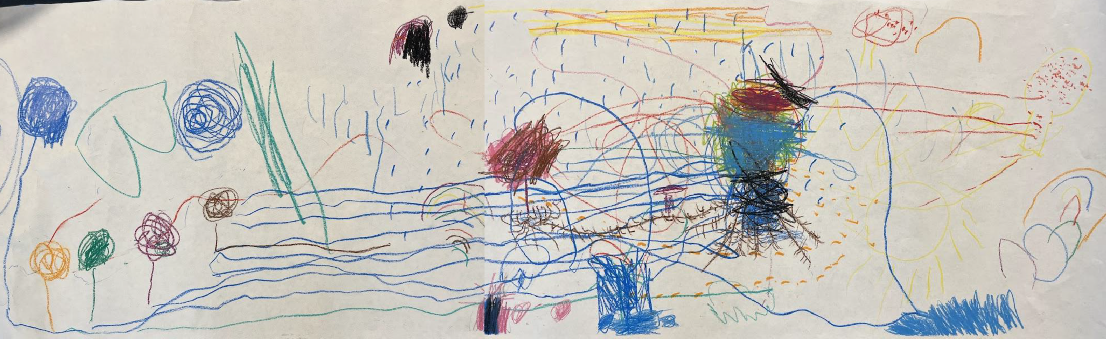
This sentiment echoed throughout the classroom. Isla and Aroon, working on a collective drawing, reframed "poisonous" mushrooms as protectors that shield baby trees from bugs. They began to draw "love points" where roots connect, imagining a "Love Town" where even the most dangerous inhabitants are given water and, in return, send "good energy" back into the trees.
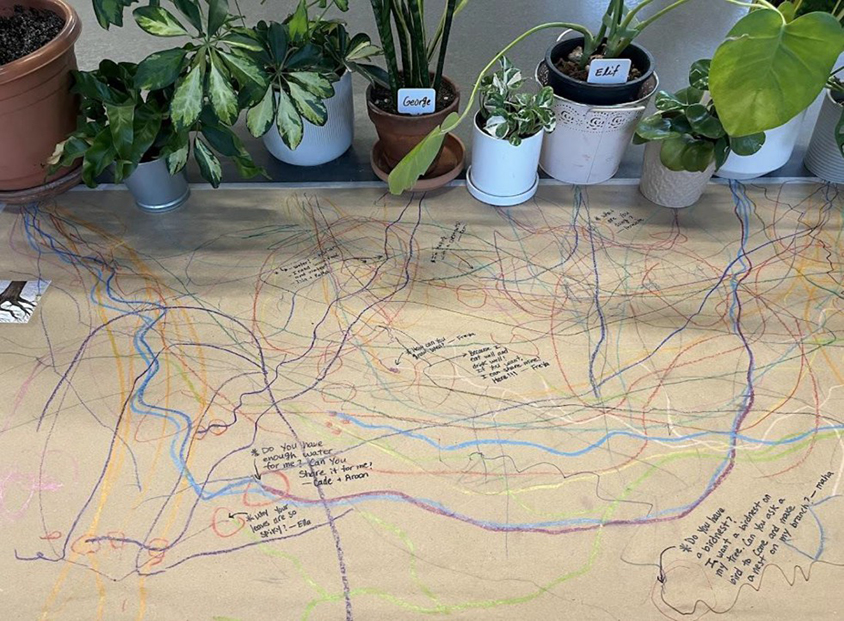
Nature as a Mirror of Community
The children’s play suggests that nature and family are "one and the same" in their minds. We witnessed this in several moving moments:
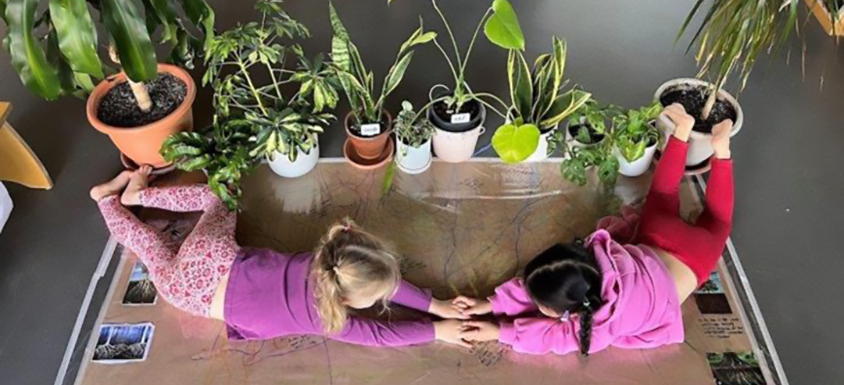
Physical Connection: Winnie and Remi used their own bodies as roots, stretching across the floor to hold hands. "Now we are connected, so we can communicate!" they cheered, as pink "love fabric" was tied around their wrists.
Emotional Justice: When a tree in their drawing was "dying," children didn't just offer water. Isla offered a sunset. She transferred a warm memory of a sunset she saw with her mom onto the paper, believing that sharing beauty was just as vital for survival as physical resources.
The Act of Repair: When a clay piece broke, Daniel spoke tenderly to it: "You will be okay. I will send you love." By touching the broken roots together, he reminded us that belonging doesn't require perfection.
Pedagogical Reflection
These moments remind us to trust children's deep instincts for social justice. They do not seek to exclude the "villain"; they seek to bring them into the circle.
Through this inquiry, the children have taught us that a community, whether a forest or a classroom, is built on mutual support. It is a place where roots are pathways for generosity, and where everyone, no matter how "poisonous" they might first appear, has a place to belong.
Questions for Further Reflection:
How do children’s personal memories (like Isla's sunset) reshape their understanding of the natural world?
In what ways can we, as adults, move past "good vs. bad" narratives to support children's more sophisticated views of justice?
How does treating nature as a "friend or family member" change the way children approach environmental stewardship?